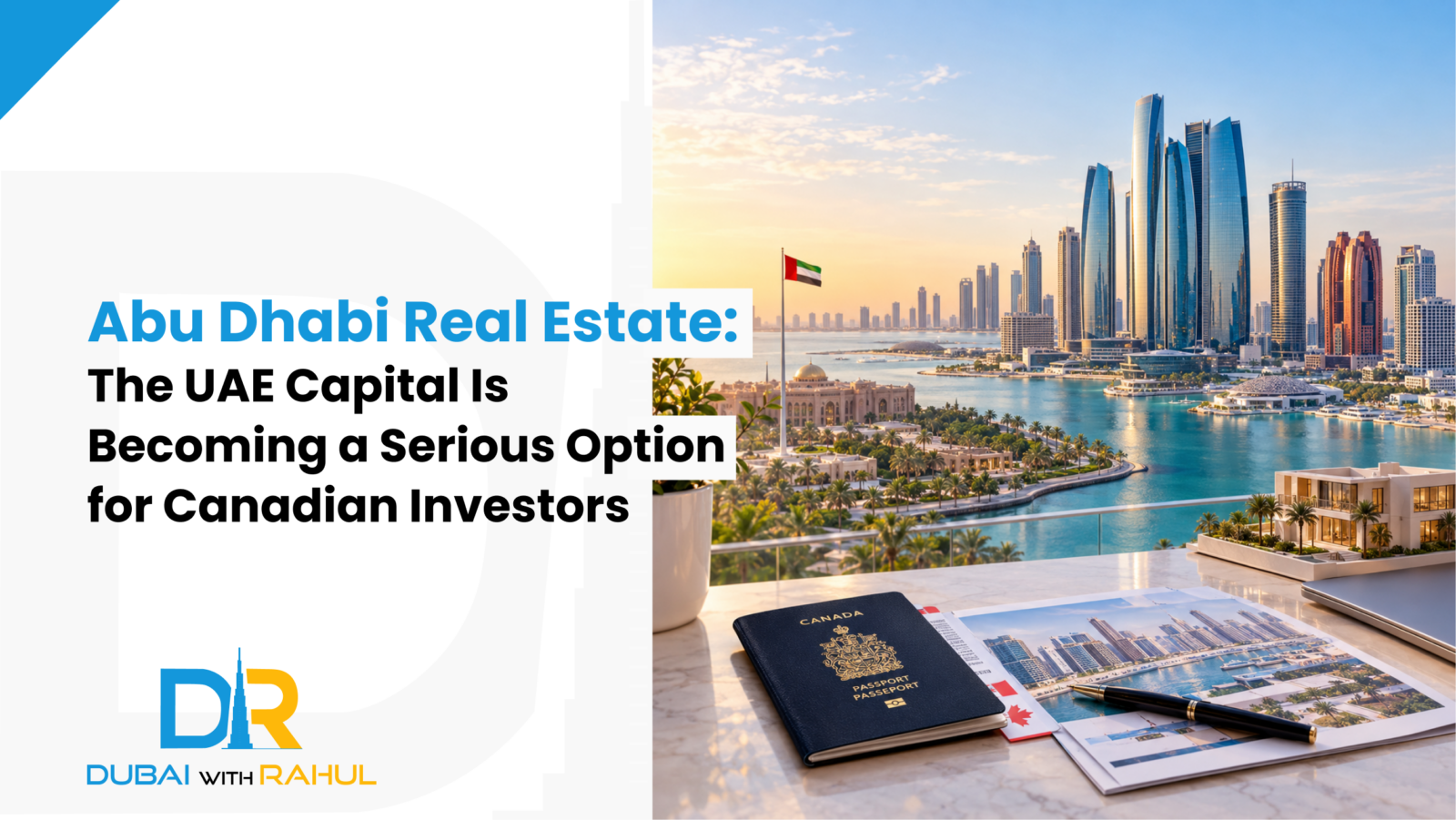
When Canadian investors think about UAE property, the conversation almost always starts and ends with Dubai. The numbers coming out of Abu Dhabi over the past year suggest that conversation is due for an update. The UAE capital recorded AED 142 billion in property transactions in 2025, up 48 percent on the year before, and then posted AED 117 billion in the first half of 2026 alone, a 112 percent increase year on year. For Canadian investors comfortable with UAE property but looking for a differentiated opportunity, Abu Dhabi is worth genuine consideration.
The Structural Story Behind Abu Dhabi’s Growth
Abu Dhabi’s momentum is built on five identifiable engines rather than short-term hype. The emirate sits on some of the world’s deepest sovereign capital pools through funds like ADIA, Mubadala, and ADQ. It hosts a fast-scaling AI and data centre sector, anchored by a 5GW UAE-US AI campus and over $100 billion in AI-focused capital now held within ADGM entities. Ownership rules have opened significantly, with freehold access for all nationalities across 50 designated investment zones, alongside escrow protections and 10-year Golden Visas. Major destination infrastructure, including the Guggenheim Abu Dhabi, Etihad Rail, and a planned Disney resort on Yas Island, is expanding the city’s global appeal. And supply is deliberately paced, with the top 10 developers accounting for 90 percent of off-plan sales.
Where Canada Fits Into the Buyer Base
Canadian buyers already feature explicitly among Abu Dhabi’s top resident-expat purchaser groups, alongside China, Egypt, France, India, Jordan, Pakistan, Russia, the UK, and the US, a list drawn directly from the emirate’s own H1 2026 buyer data. The number of investor nationalities active in the market climbed from 82 to 116 in a single year, reflecting how quickly Abu Dhabi’s international buyer base is broadening. For Canadians already weighing property in a market with no annual property tax and no capital gains tax, the same case that has drawn Canadian buyers to Dubai applies with equal force in Abu Dhabi.
The Numbers That Matter
Foreign direct investment into Abu Dhabi real estate reached AED 13.8 billion in the first half of 2026, up 309 percent year on year and already ahead of the whole of 2025. Residential sales value hit AED 70.4 billion in H1 2026, nearly triple the AED 25.3 billion recorded a year earlier, with 89 percent of that value transacted off-plan. Apartments in repeat sales rose 20 percent year on year and villas rose 12 percent, with standout communities like Al Reef posting apartment value growth above 40 percent. The luxury segment moved even faster: 1,406 homes sold above AED 10 million in H1 2026, up from just 270 homes a year earlier.
Abu Dhabi Versus Dubai: A Practical Comparison
Dubai remains substantially larger, recording AED 917 billion in transactions in 2025 against Abu Dhabi’s AED 142 billion, roughly six times the size, with far greater liquidity and a much larger base of private developers. What Abu Dhabi offers instead is a lower registration fee of around 2 percent compared with Dubai’s 4 percent, a smaller number of government-backed master developers managing supply carefully to avoid oversupply, and a growth narrative anchored more directly in sovereign capital and long-term infrastructure investment. For Canadian investors, the practical takeaway is that Abu Dhabi works best as a diversifier alongside a Dubai holding rather than a straight substitute.
Communities and Indicative Yields
Gross rental yields vary considerably by community. Al Reef and Al Ghadeer, both entry-level communities, offer among the highest yields in the market at 7 to 9 percent. Masdar City, the sustainable tech free zone, offers around 8 percent. Al Reem Island, home to the ADGM financial free zone and notably outside the June 2026 rent freeze, offers 6.5 to 8.5 percent. Yas Island, home to Formula 1, theme parks, and the upcoming Disney resort, offers 6 to 8 percent, an area likely to appeal to Canadian families given its entertainment and lifestyle focus. Saadiyat Island, the cultural and luxury hub where the Guggenheim opens in December 2026, trades at lower yields of 4 to 6 percent but has produced some of the strongest capital appreciation in the market.
The Golden Visa for Canadian Buyers
A property investment of AED 2 million or more, roughly CAD 730,000, qualifies for a renewable 10-year UAE Golden Visa in Abu Dhabi on the same terms as Dubai, extending to spouse and children, with off-plan and mortgaged properties potentially eligible depending on the paid-up portion of the investment. For Canadian investors already weighing a Golden Visa purchase in Dubai, this means Abu Dhabi can be evaluated on investment merit and lifestyle fit alone, since the residency pathway itself is identical between the two cities.
What’s Being Built Next
Several major master plans are shaping where Abu Dhabi’s next growth phase will land. Modon’s Hudayriyat Island was the single largest community by sales value in H1 2026, accounting for 27 percent of the market with AED 19 billion in sales, built around golf, beaches, and mansion-style villas. Aldar’s Marsa Al Saadiyat is a AED 100 billion master plan expected to house over 58,000 residents, with home sales beginning in the second half of 2026. Fahid Island, another Aldar project, is a AED 40 billion development with over 6,000 homes and 4.6 kilometres of beachfront between Yas and Saadiyat.
Risks to Weigh Before Investing
Abu Dhabi’s growth has come with real short-term volatility that Canadian investors should factor in. Second-quarter 2026 transaction value fell roughly 24 percent from the first quarter, and secondary market deals dropped 18 percent year on year. A rent freeze introduced in June 2026 caps rent increases on renewals and new leases outside ADGM areas, with no announced end date. Some established villa communities softened in price even as apartments kept climbing, and with 89 percent of residential value transacted off-plan, developer delivery timelines remain a meaningful underwriting consideration.
Why Choose Dubai with Rahul
Finding the right property is only half the job. The other half is finding someone who can guide you through a foreign legal system, a different currency, and a market that moves fast. This is where Rahul comes in.
Rahul is the Associate Director at Unique Properties and has spent more than 14 years working exclusively in UAE real estate, including the Abu Dhabi market. In that time, he has sold over 100 properties, closed more than 3 billion AED in transactions, and worked with clients from over 100 different nationalities, many of them investing from overseas without ever setting foot in the UAE before completing the purchase. His success rate sits above 95 percent, and he has been recognised with multiple industry awards, including the Dubai Property Awards and the International Property Awards for Best Real Estate Consultant in Dubai.
What sets Rahul apart for overseas buyers specifically is the end-to-end support. He does not just show you listings. He advises on budget and goals, connects you with leading developers active in both Dubai and Abu Dhabi, and stays with you through site visits, legal documentation, and the final transfer of ownership. For an investor buying from thousands of miles away, deciding between Dubai and Abu Dhabi, or splitting an allocation between both, that local guidance matters more than almost anything else.
If you are ready to explore your options, working with an experienced advisor to Buy Property in Abu Dhabi from Canada is the safest way to get a shortlist built around your budget, goals, and timeline.
Final Thoughts
Abu Dhabi has shifted from a quiet, government-led market into one of the fastest-growing property markets in the region, and Canadian buyers are already part of that story. For investors comfortable with UAE property but looking for a differentiated entry point, backed by sovereign capital, a fast-scaling AI economy, and controlled supply, Abu Dhabi is increasingly hard to ignore.