
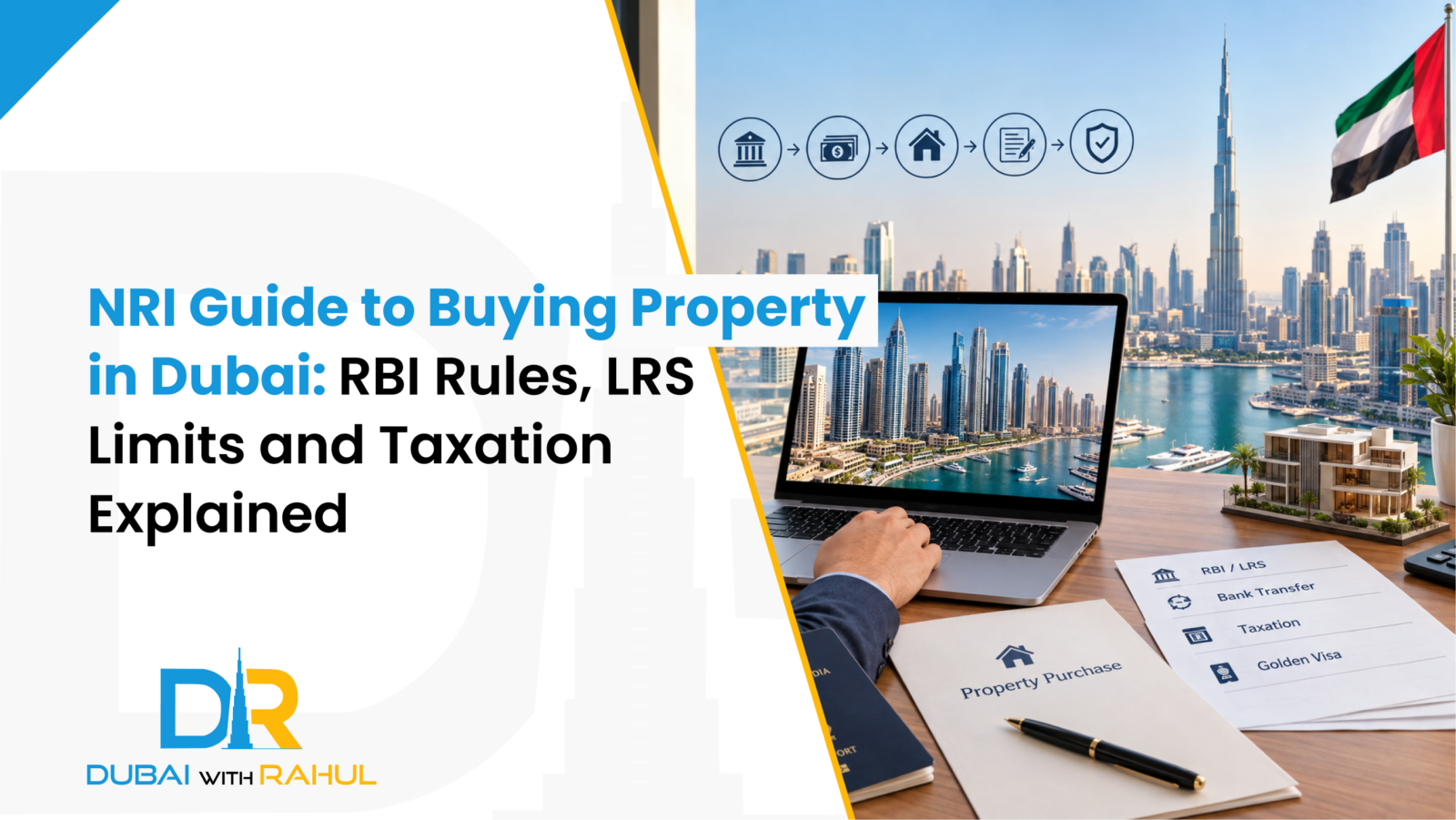
Dubai has become one of the most popular international property destinations for Non-Resident Indians, and the reasons go well beyond lifestyle appeal. Zero property tax, strong rental yields, proximity to India, and a large existing Indian community in the UAE have all contributed to sustained NRI investment in Dubai real estate. This guide covers exactly what NRIs need to know before buying, including RBI rules, LRS limits, and how the taxation actually works.
Why NRIs Are Choosing Dubai Real Estate
For many NRIs, Dubai offers something Indian real estate cannot: freehold ownership in a global city with no property tax, no capital gains tax, and no tax on rental income at the local level. Add average rental yields of 6 to 9 percent in areas like Dubai Marina, Business Bay, and Jumeirah Village Circle, well above typical yields in most major Indian cities, and the appeal becomes clear. Dubai’s roughly three-hour flight time from most major Indian cities and its large, established Indian expatriate community also make it a far more familiar and accessible market than other international options.
Can NRIs Buy Property in Dubai?
Yes. NRIs can purchase freehold property in designated zones of Dubai with full ownership rights, registered directly with the Dubai Land Department. There is no requirement to be a UAE resident, and the process can be initiated from India, though a site visit before finalising a purchase, particularly for resale property, is strongly advisable.
RBI Rules for Buying Property in Dubai
Under the Reserve Bank of India’s Liberalised Remittance Scheme (LRS), resident Indians are permitted to remit up to USD 250,000 per financial year for permitted current and capital account transactions, which includes the purchase of immovable property abroad. This is the single most important rule for Indian investors to understand before committing to a Dubai purchase.
Key points under the LRS framework:
- The USD 250,000 limit applies per individual, per financial year, so a family of four (all adults) can collectively remit up to USD 1 million annually if each family member is an independent remitter with their own funds.
- Funds must be transferred through an authorised dealer bank in India, with proper documentation of the purpose of remittance.
- The remittance cannot be used for purposes explicitly prohibited under LRS, such as margin trading or lottery participation, but real estate purchase abroad is a permitted use.
- NRIs remitting from NRE or NRO accounts, rather than directly from India, operate under a related but distinct set of rules, and it is worth confirming the correct route with your bank based on your specific NRI status and account structure.
LRS Limit for Dubai Property Purchase: Practical Planning
Given the USD 250,000 annual LRS limit, a higher-value Dubai property purchase may need to be structured across more than one financial year, split between family members who are each independent remitters, or paid partly through an existing NRE/NRO account balance or developer payment plan that spreads payments over time. This is one of the most common planning points that first-time NRI buyers overlook, and it is worth mapping out before you reserve a unit, not after.
Step-by-Step Process for NRI Buyers
- Confirm your remittance capacity under LRS and plan the payment structure accordingly.
- Shortlist properties with a local advisor who can share verified listings, developer track records, and video walkthroughs.
- Reserve the unit with a booking deposit, typically 5 to 10 percent for off-plan property.
- Sign the Sale and Purchase Agreement, or for resale property, the RERA Form F Memorandum of Understanding.
- Remit funds through your authorised dealer bank into the developer’s escrow account or the Dubai Land Department trustee account.
- Register the title deed with the Dubai Land Department once payment and documentation are complete.
Taxation for Indian Investors
Locally, Dubai imposes no property tax, no capital gains tax, and no income tax on rental earnings. However, as an Indian tax resident (or NRI, depending on your residential status under Indian tax law), any rental income or capital gain from the Dubai property may still be relevant to your Indian tax filing, depending on your residential status and applicable Double Taxation Avoidance Agreement (DTAA) provisions between India and the UAE. It is important to consult a chartered accountant familiar with NRI taxation to confirm how your specific situation should be reported and whether any DTAA relief applies.
The Dubai Golden Visa for NRI Investors
Property investment of AED 2 million or more (roughly INR 4.5 crore) qualifies the investor for a renewable 10-year UAE Golden Visa, extending to spouse and children. For many NRI families, this has become as important a factor as the rental return itself, offering long-term residency stability in the UAE alongside the investment.
Documentation NRIs Typically Need
Most Dubai property purchases by NRIs require a valid passport, proof of address, bank statements showing source of funds, and in some cases an NRI-specific declaration confirming the funds being remitted comply with LRS regulations. If purchasing jointly with a spouse or family member, both parties typically need to provide their own documentation, since Dubai title deeds can be issued in joint names. Keeping remittance records organised from the start also makes life considerably easier if you need to demonstrate the funding trail to your bank or to Indian tax authorities later.
Areas Popular Among NRI Investors
Dubai Marina and Business Bay remain consistently popular with NRI investors for their strong rental demand and relatively accessible entry prices within the AED 1 to 2 million range. Jumeirah Village Circle has also drawn significant NRI interest for its lower per-square-foot pricing and healthy yields, making it a common choice for investors prioritising cash flow. For those targeting the Golden Visa threshold specifically, Dubai Hills Estate and select Business Bay towers offer strong options that comfortably clear the AED 2 million mark while still delivering competitive rental income.
Why Choose Dubai with Rahul
Finding the right property is only half the job. The other half is finding someone who can guide you through a foreign legal system, a different currency, and a market that moves fast. This is where Rahul comes in.
Rahul is the Associate Director at Unique Properties and has spent more than 14 years working exclusively in Dubai real estate. In that time, he has sold over 100 properties, closed more than 3 billion AED in transactions, and worked with clients from over 100 different nationalities, many of them investing from overseas without ever setting foot in Dubai before completing the purchase. His success rate sits above 95 percent, and he has been recognised with multiple industry awards, including the Dubai Property Awards and the International Property Awards for Best Real Estate Consultant in Dubai.
What sets Rahul apart for overseas buyers specifically is the end-to-end support. He does not just show you listings. He advises on budget and goals, connects you with leading developers such as Emaar, Damac, Nakheel, Meraas, and Sobha for exclusive access to premium and early-launch projects, and stays with you through site visits, legal documentation, and the final transfer of ownership. For an investor buying from thousands of miles away, that continuity matters more than almost anything else.
If you are ready to explore your options, working with an experienced advisor to Dubai property investment for NRIs is the safest way to get a property shortlist built around your budget, goals, and timeline.
Final Thoughts
Dubai property investment for NRIs is well-regulated and increasingly straightforward, but LRS planning, remittance timing, and documentation still require care, particularly for higher-value purchases. Getting this right from the outset avoids delays and ensures your investment is structured properly from day one.